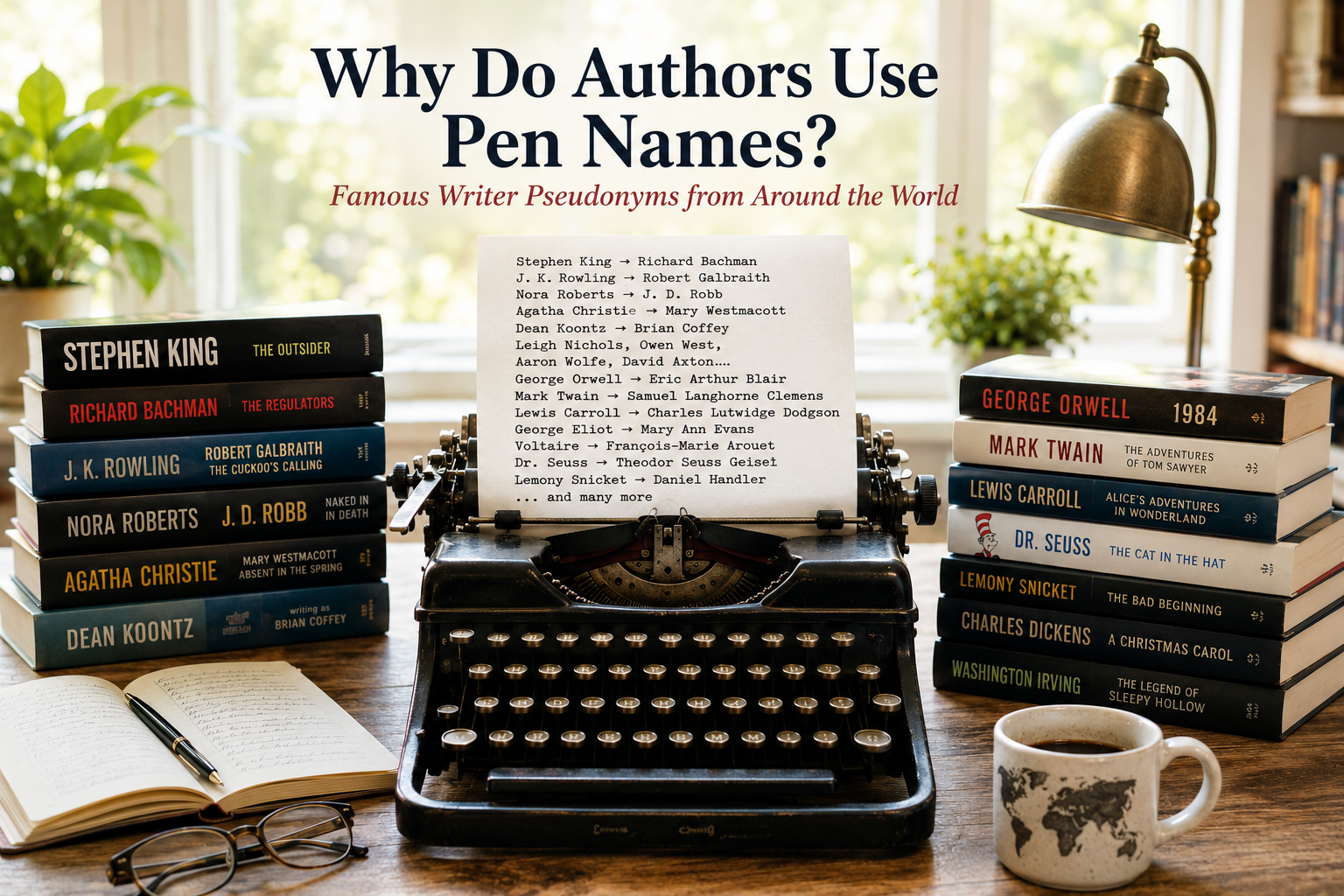

Why Do Authors Use Pen Names? The Stories Behind Famous Writer Pseudonyms
Did you know that some of the world's most famous books were published under names that were not the authors' real names? From Stephen King and J. K. Rowling to Mark Twain and George Orwell, pen names have shaped literary history for centuries. Let's discover why writers choose different names and meet some of the most famous literary pseudonyms ever created.
Why do authors use pen names?
When you pick up a book, you probably assume that the name on the cover belongs to the person who wrote it.
But that is not always true.
Many famous authors have written under a different name. Sometimes readers know the pen name better than the writer's real name.
For example:
- George Orwell was born Eric Arthur Blair.
- Mark Twain was actually Samuel Langhorne Clemens.
- Lewis Carroll was Charles Lutwidge Dodgson.
- George Eliot was Mary Ann Evans.
Today, pen names are just as popular as they were hundreds of years ago.
What is a pen name?
A pen name (also called a pseudonym) is a name an author chooses instead of their real one.
The important thing is this:
The author still writes the book. Only the name on the cover is different.
A pen name can be:
- a completely invented name,
- a shorter version of the real name,
- initials,
- or even a name that sounds like it belongs to someone from another country.
Why do writers use pen names?
There isn't just one reason.
Different writers have different goals.
Some want to:
- write in a new genre,
- separate different groups of readers,
- protect their private life,
- create a stronger personal brand,
- use a name that is easier to remember,
- or simply have more creative freedom.
Sometimes the pen name becomes even more famous than the real name.
Writing different genres
One of the most common reasons for using a pen name is to separate different kinds of books.
Readers often have certain expectations. Someone looking for a romance novel may not expect a dark crime thriller from the same author.
A different name helps avoid confusion.
Nora Roberts → J. D. Robb
Nora Roberts became one of the world's best-known romance writers.
When she started writing futuristic crime novels featuring detective Eve Dallas, she introduced a new author: J. D. Robb.
Today both names are bestselling brands, but readers immediately know what type of story to expect.
An interesting fact is that Nora Roberts is also a pen name. The author's birth name is Eleanor Marie Robertson.
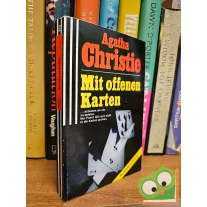
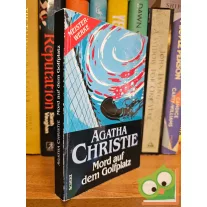
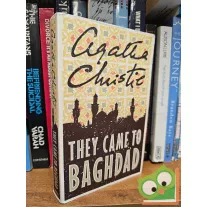
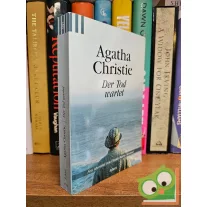
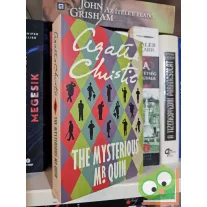
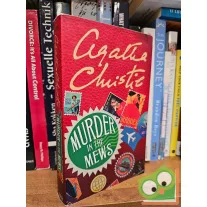
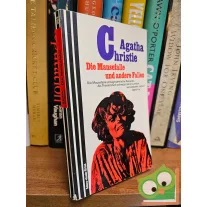
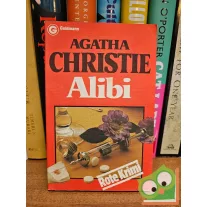
Agatha Christie → Mary Westmacott
Agatha Christie is known around the world as the Queen of Crime.
However, she also wanted to write emotional novels about love, relationships and family life.
Instead of publishing them as Agatha Christie, she chose the name Mary Westmacott.
This allowed readers to approach those books without expecting another Poirot mystery.
J. K. Rowling → Robert Galbraith
J. K. Rowling became one of the world's most successful writers thanks to Harry Potter.
After finishing the series, she wanted to publish detective novels for adults.
Instead of using her famous name, she created Robert Galbraith.
For several months, readers believed Galbraith was a completely new crime writer.
Only later did the truth become public.
There is another interesting story behind Rowling's name.
Her publisher believed that young boys might be less interested in reading a fantasy novel written by a woman.
Because Joanne Rowling has no middle name, the publisher suggested using the initial K, taken from her grandmother Kathleen.
That is how the name J. K. Rowling was created.
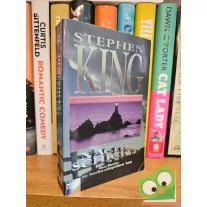
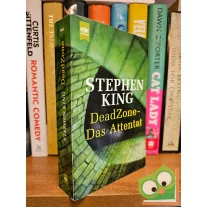
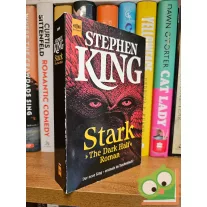
Stephen King → Richard Bachman
Stephen King has one of the most famous pen-name stories in publishing.
In the late 1970s, publishers believed readers would not buy several books each year by the same author.
King was writing much faster than they wanted to publish.
So he invented Richard Bachman.
Several novels—including Rage, The Long Walk, Roadwork and The Running Man—first appeared under that name.
The name itself also has an interesting history.
King borrowed "Richard" from crime writer Richard Stark, who was actually another pen name used by Donald E. Westlake.
"Bachman" came from the rock band Bachman-Turner Overdrive, which happened to be playing while King was thinking of a name.
When readers finally discovered that Richard Bachman and Stephen King were the same person, sales of the Bachman books increased dramatically.
Later, King jokingly announced that Richard Bachman had "died of cancer of the pseudonym."
Dean Koontz - the master of multiple pen names
Dean Koontz didn't stop at just one pen name.
During his early career he published books under many different names, including:
- Brian Coffey
- Leigh Nichols
- Owen West
- Aaron Wolfe
- David Axton
- Deanna Dwyer
- K. R. Dwyer
- Richard Paige
- John Hill
- Anthony North
Some of these names were used because publishers wanted variety. Others helped separate different genres or publishing contracts.
Today, most readers know these books as Dean Koontz novels, but many were first published under completely different names.
Some of the world's most famous pen names
Many pen names have become legendary.
Here are some of the best-known examples:
| Pen name | Real name |
|---|---|
| George Orwell | Eric Arthur Blair |
| George Eliot | Mary Ann Evans |
| Mark Twain | Samuel Langhorne Clemens |
| Lewis Carroll | Charles Lutwidge Dodgson |
| Voltaire | François-Marie Arouet |
| Lemony Snicket | Daniel Handler |
| Dr. Seuss | Theodor Seuss Geisel |
| Barbara Vine | Ruth Rendell |
| E. L. James | Erika Mitchell (later Erika Leonard) |
Some readers know the pen name for decades without ever learning the real name behind it.